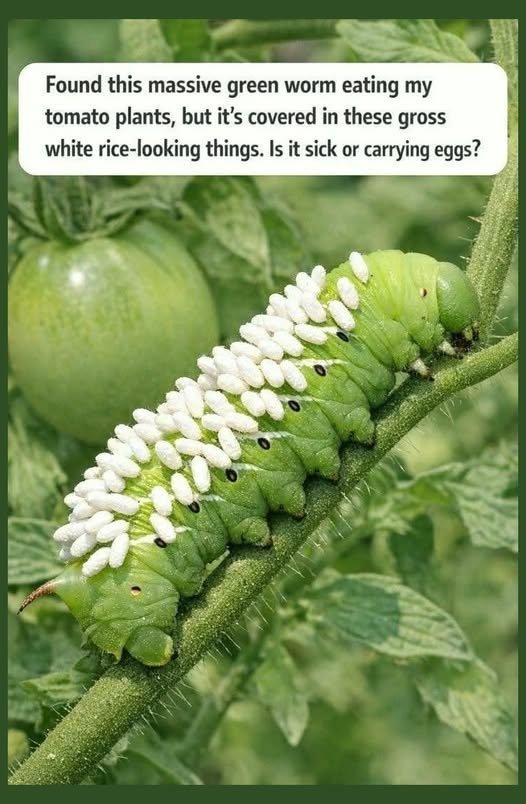
If you were tending your tomato plants and suddenly discovered a huge green caterpillar covered with dozens of strange white, rice-shaped objects, you might assume the caterpillar is sick—or that it is carrying eggs.
But something much more fascinating is happening.
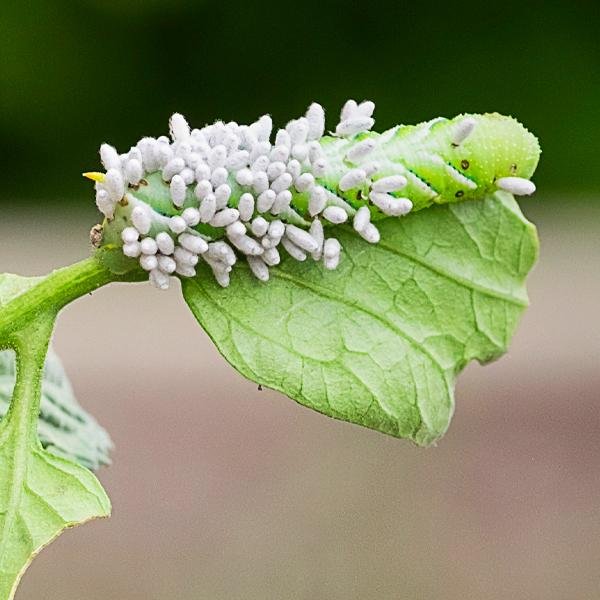
The green caterpillar is most likely a tomato or tobacco hornworm, and those little white objects are cocoons belonging to parasitic braconid wasps.
In other words, the caterpillar isn’t carrying eggs.
It has been parasitized.
Those White “Rice Grains” Aren’t Eggs
The white structures attached to the caterpillar are individual wasp cocoons.
A female braconid wasp lays her eggs inside a hornworm. The developing wasp larvae feed inside the caterpillar, eventually emerging through its skin.
Once outside, the larvae spin tiny white cocoons on the caterpillar’s body.
That’s why the caterpillar looks as though someone covered it with grains of white rice.
It is actually an extraordinary example of the natural battle taking place in a garden.
Should You Kill the Caterpillar?
No—if you can avoid it.
Although hornworms can cause significant damage to tomato plants, a hornworm covered in wasp cocoons has already become a host for beneficial parasitoids.
The adult wasps that eventually emerge can go on to parasitize other hornworms.
So instead of immediately removing or crushing the caterpillar, many gardeners choose to leave it alone.
Nature may be doing some pest control for you.
Hornworms Can Be Serious Tomato Pests
A healthy hornworm can eat an astonishing amount of foliage.
They are large, green caterpillars that can blend surprisingly well among tomato leaves. Sometimes the first sign of an infestation isn’t seeing the caterpillar itself—it’s discovering that large sections of a tomato plant have suddenly disappeared.
They can also feed on other plants in the nightshade family.
That’s why gardeners often become alarmed when they find one.
But not every hornworm should necessarily be treated the same way.
A hornworm without parasitoid cocoons may need to be removed if it is causing serious damage. A hornworm already covered with wasp cocoons, however, is a very different situation.
What Happens Next?
The tiny parasitoid larvae have already completed much of their development inside the caterpillar.
After emerging, they form their characteristic white cocoons.
Eventually, adult wasps emerge from those cocoons and fly away.
These wasps are generally tiny and not interested in attacking people. Their importance is in controlling caterpillar pests.
The entire scene may look unpleasant, but from an ecological perspective, it’s quite remarkable.
Nature’s Own Pest-Control System
Gardeners sometimes think of insects as simply “good” or “bad.”
The reality is much more complicated.
A tomato plant may attract a hornworm that wants to eat its leaves. That hornworm may then attract a parasitoid wasp that attacks the hornworm.
So one insect becomes food or a host for another, helping regulate populations naturally.
This is one reason biodiversity can be so valuable in a garden.
What Should You Do If You Find One?
If you see a hornworm covered in white cocoons:
Don’t disturb the caterpillar unnecessarily.
Avoid spraying broad-spectrum insecticides around it.
If possible, leave it on the plant or move it carefully to a safe location nearby.
Keep an eye on your tomato plants for additional hornworms.
Remove un-parasitized hornworms by hand if they are causing significant damage.
If you aren’t sure what you’re looking at, taking a clear photograph and getting an identification from a local gardening or entomology expert is a good option.
9
A Horrifying Sight With a Helpful Ending
At first glance, those white objects look like something out of a science-fiction movie.
But they are actually part of a natural biological control system that can help keep hornworm populations under control.
So if you ever find a giant green caterpillar covered in tiny white “rice grains,” don’t assume it’s carrying eggs and don’t immediately destroy it.
You may be looking at one of nature’s most effective little pest-control systems at work.
Have You Ever Found One of These in Your Garden?
Would you leave the caterpillar alone after discovering what was happening—or would the sight be too creepy to get anywhere near?