Have you ever cracked open an egg and noticed that the yolk is pale yellow, golden, or deep orange?
It is easy to assume that a darker yolk must come from a healthier chicken—and many viral posts online encourage exactly that idea.
But the truth is a little more interesting.
🥚 Does Yolk Color Tell You How Healthy the Chicken Is?
Not by itself.
The color of an egg yolk is determined primarily by the hen’s diet, particularly the types and amounts of pigments called carotenoids in the feed.
A hen eating feed containing more yellow- or orange-pigmented ingredients may produce a darker yolk.
For example, a diet containing ingredients such as:
Corn
Alfalfa
Marigold meal
Certain leafy greens
Other carotenoid-rich plants
can influence yolk color.
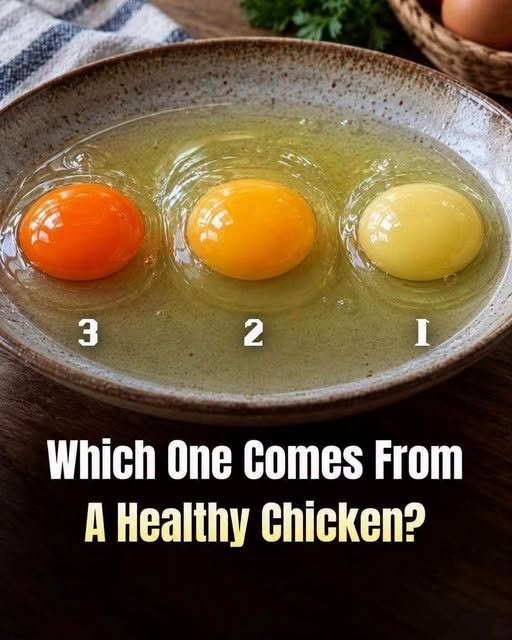
So, in the image, egg #3 isn’t automatically healthier simply because its yolk is the darkest.
Likewise, the pale yolk in #1 doesn’t automatically mean the chicken was unhealthy.
Why Are Some Yolks Bright Orange?
Deep orange yolks contain more of certain carotenoid pigments.
These natural compounds are also found in many colorful fruits and vegetables.
However, yolk color is not a reliable nutritional scorecard.
A darker yolk doesn’t necessarily mean the egg has dramatically more protein, healthier fats, or vitamins.
Two eggs with very different yolk colors can have broadly similar nutritional profiles.
What About Free-Range Eggs?
This is where things get confusing.
Free-range or pasture-raised hens may have access to grass, insects, seeds, and other foods that can influence yolk pigmentation.
As a result, some pasture-raised eggs have noticeably deeper-colored yolks.
But yolk color alone cannot prove that an egg came from a free-range, organic, or exceptionally healthy chicken.
Commercially produced eggs can also have dark yolks because their feed is formulated with ingredients that affect pigmentation.
What Does a Pale Yolk Mean?
A pale yellow yolk isn’t necessarily a sign of a sick chicken.
It may simply reflect the hen’s diet.
For example, if the feed contains fewer strongly pigmented ingredients, the yolk may naturally appear lighter.
That’s why comparing eggs based solely on color can be misleading.
Pale doesn’t automatically mean poor quality.
Does Yolk Color Affect Taste?
Sometimes people say that darker yolks taste better.
But taste depends on many factors, including:
The hen’s diet
Egg freshness
Storage conditions
Cooking method
Individual taste preferences
Some people prefer the richer appearance of orange yolks, but color alone isn’t a guarantee of superior flavor.
How Can You Tell if an Egg Is Fresh?
Instead of judging an egg by yolk color, freshness can be assessed in more useful ways.
A very fresh egg generally has a firm, rounded yolk and a thicker white that stays relatively close to it.
As an egg ages, the white tends to become thinner and the yolk may flatten and become easier to break.
If an egg smells strongly unpleasant after cracking, don’t eat it.
And always store eggs according to local food-safety guidance.
Is a Dark Orange Yolk More Nutritious?
Not necessarily.
Some research has found differences in nutrients between eggs depending on the hens’ diets, but color itself isn’t the cause.
For example, a hen’s feed can influence both yolk pigmentation and certain nutritional characteristics.
That means you shouldn’t use the color as a simple rule:
Darker yolk = healthier egg.
That’s an oversimplification.
So Which Egg in the Picture Is From the “Healthy” Chicken?
If we’re choosing based only on the yolk colors shown, there is no scientifically reliable way to identify which chicken was healthiest.
Egg #1 has a pale yolk.
Egg #2 has a medium-golden yolk.
Egg #3 has a deep orange yolk.
All three could come from healthy hens.
The difference in appearance is primarily telling us something about the hens’ diets and the pigments in their feed—not giving us a medical report about the chickens.
What Actually Matters When Buying Eggs?
If you’re looking for good-quality eggs, pay more attention to:
🐔 How the hens are raised
Labels such as free-range or pasture-raised can provide information about production practices, depending on your country’s labeling standards.
🌾 The feed
A hen’s diet can influence both yolk color and some nutritional characteristics.
📅 Freshness
Check the date and store eggs properly.
🥚 Food safety
Avoid eggs that are cracked, dirty, improperly stored, or otherwise questionable.
🏷️ Reliable labeling
Don’t rely on yolk color alone to determine how an egg was produced.
The Bottom Line
Yolk color is not a health test for the chicken.
The pale, golden, and orange yolks in the picture can all come from perfectly healthy hens. The main reason they look different is usually what the hens ate and the pigments present in their diet.
So the next time you crack an egg and see a beautiful orange yolk, enjoy it—but don’t assume that the color alone proves you’ve found a healthier egg.
The yolk’s color tells a story about diet—not a complete story about the chicken’s health. 🥚🍳