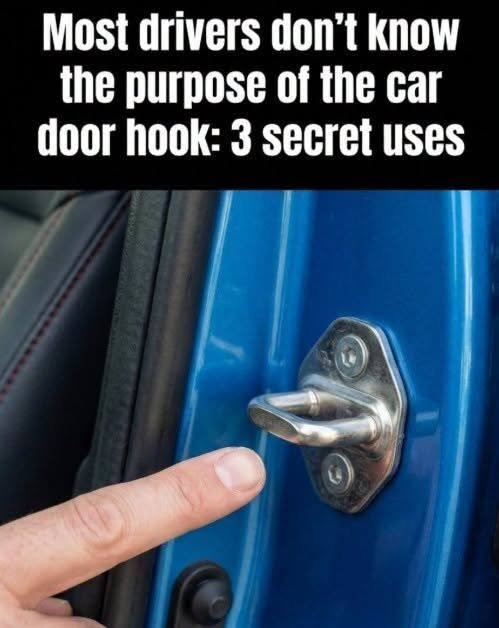
If you’ve ever opened your car door and noticed the small metal hook or loop attached to the door frame, you may have wondered what it actually does.
It looks almost too simple to be important.
And that’s exactly why it often gets overlooked.
The part shown in the photo is generally associated with the door latch and striker mechanism. Its primary job isn’t to hold shopping bags, hang clothes, or provide a secret emergency feature. It is an important part of the system that keeps the vehicle door securely closed while you’re driving.
But there are a few useful things to know about it.
What Is That Metal Hook?
The metal piece is commonly called a door striker, striker plate, or striker loop, depending on the vehicle’s design.
When you close the door, the latch mechanism inside the door grabs onto this component.
Think of it as the part the door’s locking mechanism catches onto.
The basic process works like this:
You push the door closed.
The latch on the door moves around the striker.
The latch locks onto it.
The door remains securely closed.
When you pull the interior or exterior handle, the latch releases.
So that small piece of metal plays a major role in keeping the door shut.
Why Does It Look Like a Hook?
The exact shape varies from vehicle to vehicle.
Some cars use a loop-shaped striker, while others use a differently shaped metal receiver.
The design has to withstand considerable forces because the door needs to remain securely attached to the vehicle during normal driving—and especially during sudden braking or a collision.
That’s why this isn’t simply a decorative piece of metal.
It’s part of an important vehicle safety and restraint system.
What Is the “Second Click” You Hear?
Many modern vehicle latches have multiple engagement positions.
When the door is partially closed, the latch may catch at an initial position.
When the door closes completely, it reaches the fully engaged position.
That’s why you may sometimes hear more than one click when closing a car door.
If a door doesn’t fully latch, it may remain partially closed or trigger a warning on the dashboard.
Never drive with a door that hasn’t properly latched.
Why Is the Striker Adjustable?
This is one of the more interesting things about the component.
On many vehicles, the striker can be adjusted slightly during manufacturing or servicing.
Its position helps determine how the door sits against the vehicle body and how the latch engages.
If a door is:
Difficult to close
Sitting too high or low
Making unusual noises
Requiring excessive force to shut
Developing wind noise
the latch and striker alignment may need to be inspected.
However, adjusting it yourself isn’t always a good idea.
A door latch is a safety-critical component, and incorrect adjustment can affect how securely the door closes.
Is It a Hook for Hanging Things?
This is where many viral posts become misleading.
You may see claims that the metal loop can be used to hang:
Grocery bags
Clothes
Umbrellas
Handbags
Other objects
While someone might physically hang something from certain components, the door striker should not be treated as a general-purpose hook.
It’s there primarily for the latch mechanism.
Putting weight on it or interfering with the latch could potentially damage components or prevent proper door operation.
What About Emergency Uses?
Some online posts claim that this little hook has several “secret” functions that most drivers don’t know about.
Be cautious with those claims.
The exact design and purpose vary between vehicle manufacturers and models.
A component that looks similar from the outside can have different engineering specifications depending on the car.
If you’re wondering whether a particular feature has an additional purpose, the vehicle owner’s manual is the best source.
What Happens if the Striker Is Damaged?
Because the striker is involved in keeping the door closed, damage shouldn’t be ignored.
Warning signs can include:
The door doesn’t close normally
The door bounces back open
The latch doesn’t engage properly
Excessive rattling
A door warning light remains illuminated
The door appears misaligned
Unusual wind noise develops
If you notice any of these problems, have the latch and striker inspected.
A door that doesn’t reliably latch is a safety issue, not merely an annoyance.
Why Is It So Strong?
The striker is designed to work with the latch as part of the vehicle’s body structure.
During a crash, the vehicle’s doors need to remain closed as much as possible.
A properly functioning latch and striker help prevent unintended door opening and contribute to occupant protection.
Modern vehicles also use additional structural reinforcements and restraint systems, including seat belts and airbags.
So that little piece of metal is part of a much larger safety system.
Don’t Spray Random Lubricants on It
Another common mistake is spraying anything available onto the latch or striker when the door starts making noise.
Some manufacturers have specific recommendations for lubricating door latches.
Using the wrong product can attract dirt or affect the mechanism.
If the latch is squeaking, sticking, or becoming difficult to operate, check the owner’s manual or have the mechanism serviced rather than assuming any lubricant will work.
A Simple Maintenance Check
You don’t need to dismantle anything to check whether your car door is behaving normally.
With the vehicle parked safely, pay attention to whether:
The door closes smoothly.
You hear the latch engage.
The door sits flush with the body.
The door opens normally from both handles.
There are no unusual rattles or grinding sounds.
If something suddenly changes, don’t ignore it.
A small problem with a door mechanism can become a significant safety problem if the door no longer latches correctly.
The Bottom Line
That small metal “hook” on your car door isn’t really a mysterious secret gadget.
It’s generally part of the door latch and striker system, whose most important job is to make sure the door stays securely closed.
It may look insignificant, but it’s a carefully engineered component that plays an important role in everyday vehicle safety.
So the next time you notice that little metal loop, remember:
It’s not just a hook—it’s part of what keeps your car door securely shut. 🚗
And if your door ever becomes difficult to close or doesn’t latch properly, don’t experiment with the mechanism. Have it inspected before driving.