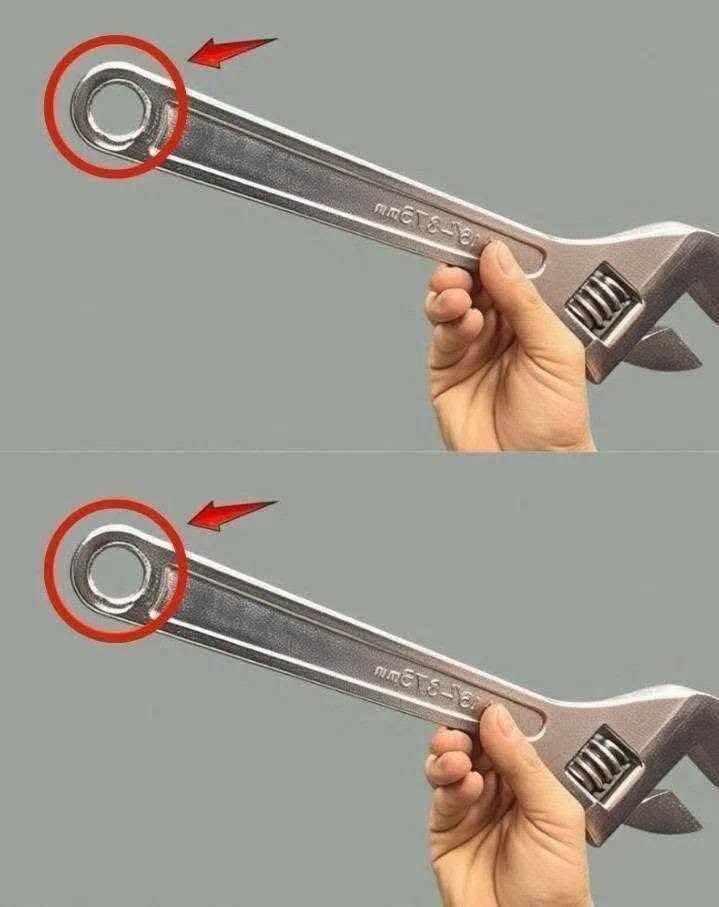
You’ve probably seen an adjustable wrench countless times.
It’s one of those simple tools that can be found in almost every toolbox, garage, workshop, and home. But have you ever noticed the round hole at the end of the handle?
Many people assume it’s simply part of the design. Others believe it has a hidden function that can make using the wrench easier.
So, what is that hole actually for?
The Main Purpose: Easy Storage
The most common purpose of the hole at the end of an adjustable wrench is surprisingly simple: it allows the wrench to be hung up for storage.
You can place the hole over a hook, peg, nail, or tool-storage rack.
Instead of leaving the wrench in a toolbox or on a workbench, you can hang it where it is easy to see and reach.
This is particularly useful in workshops where tools are organized on pegboards or wall-mounted storage systems.
Why Is the Hole Located at the End?
Tool designers place the hole at the end of the handle because it provides a convenient hanging point without interfering with the working part of the wrench.
The adjustable jaws need to remain unobstructed so they can grip different sizes of nuts and bolts.
Putting a hole near the end of the handle also keeps it away from the main area where your hand applies force.
Is There Another Use for the Hole?
Depending on the wrench design, the opening can have additional practical uses.
For example, it may be used to:
Hang the tool on a workshop pegboard
Attach the wrench to a storage hook
Keep tools organized and visible
Attach a suitable tool tether in professional environments
Help manufacturers hang tools during display or storage
However, many viral posts exaggerate the purpose of the hole and claim that it is a special mechanism for performing a particular mechanical trick.
Unless the manufacturer specifically designed the opening for another function, its primary purpose is generally convenient storage.
Why Adjustable Wrenches Have This Design
An adjustable wrench is designed around a movable jaw.
By turning the worm screw, you can move the adjustable jaw closer to or farther from the fixed jaw. This allows one wrench to work with several different nut and bolt sizes.
The handle must therefore be strong enough to withstand substantial force.
The hole at the end does not control the jaw mechanism. Instead, it is located in the handle, where it can provide a useful storage point without affecting the wrench’s primary function.
A Simple Way to Organize Your Tools
If you have several adjustable wrenches, using the holes to hang them can make your toolbox or workshop much easier to organize.
You can install hooks or use a pegboard to keep frequently used tools within reach.
This has another advantage: you can immediately see which tool you need instead of digging through a crowded toolbox.
Good tool organization can save time, especially if you regularly work on household repairs, cars, machinery, or DIY projects.
Don’t Confuse It With the Jaw Opening
The circular hole at the end of the handle is completely different from the opening between the adjustable wrench’s jaws.
The jaws are the working portion of the tool. They grip the sides of a nut or bolt so you can turn it.
The round hole, on the other hand, generally has nothing to do with adjusting the wrench.
That’s why you can hang the wrench from the hole without affecting how the adjustable jaw operates.
Why Does This Look Like a “Secret”?
The reason this feature seems mysterious is probably because most people simply use the wrench without thinking about its design.
Tools often contain small features that have practical purposes but aren’t explained every time you buy them.
A hole, groove, notch, or opening may be included for storage, manufacturing, handling, or compatibility with other equipment.
In this case, what looks like a hidden trick is usually just a very practical design feature.
A Word of Caution About Viral Tool Hacks
Social media is full of posts claiming that ordinary tools have “secret” functions.
Some of these tips are genuinely useful, but others are exaggerated or simply incorrect.
Before using a tool in an unusual way, it’s best to check the manufacturer’s instructions and make sure the technique won’t damage the tool or create a safety hazard.
An adjustable wrench should be used for its intended purpose, and you should avoid extending the handle with another object to gain extra leverage unless the manufacturer specifically permits it.
The Bottom Line
So, what is that mysterious hole in an adjustable wrench actually for?
Most commonly, it’s a hanging hole designed to make storage easier.
It allows the wrench to be placed on a hook, peg, nail, or tool rack so it can be stored neatly and accessed quickly.
It may look like a tiny detail, but it’s a good example of how practical tool design often focuses on convenience as well as function.
The next time you pick up an adjustable wrench, take a look at that little hole.
It’s probably not a secret mechanical trick after all — it’s simply a clever way to keep your tools organized.
Frequently Asked Questions
What is the hole in an adjustable wrench for? The hole at the end of many adjustable wrench handles is primarily designed for hanging and storing the tool.
Can I use the hole to turn nuts or bolts? The hole is generally not intended to be used as a replacement for the wrench’s jaws. Use the adjustable jaws to grip and turn nuts and bolts.
Can the wrench be hung on a pegboard? Yes. If the hole is appropriately sized, it can be placed over a peg or hook for convenient storage.
Does every adjustable wrench have a hole? No. Designs vary between manufacturers and models. Some adjustable wrenches have hanging holes, while others may have different handle designs.
Is the hole part of the adjustment mechanism? No. The adjustment mechanism is the movable jaw and worm screw. The hole in the handle is generally separate from that mechanism.
Final Takeaway
Sometimes the “secret” behind a familiar tool isn’t complicated at all.
That small hole is a simple feature designed to make your adjustable wrench easier to store, organize, and access — proving that even the smallest details in everyday tools can have a practical purpose.