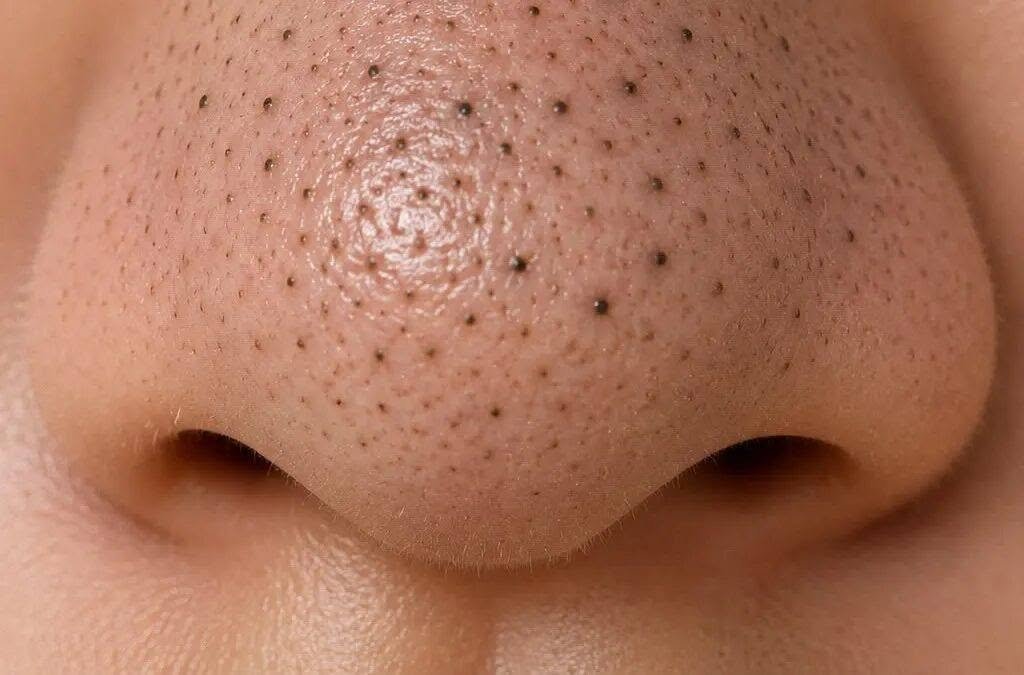
If you have ever looked closely at your nose and noticed dozens of tiny dark dots, you may have assumed they were stubborn blackheads.
The internet is full of homemade remedies promising to “pull out” these spots using ingredients such as baking soda, toothpaste, lemon juice, salt, or other kitchen products. Some posts even claim that rubbing a special mixture onto the nose will leave the skin completely smooth and make enlarged pores disappear.
But there is an important problem with many of these viral remedies:
Not every dark dot on your nose is a blackhead, and harsh DIY mixtures can irritate your skin rather than improve it.
So what are those tiny dots, and what is the safest way to deal with them?
First: Are Those Actually Blackheads?
Not necessarily.
The nose naturally contains a large number of sebaceous glands. These glands produce sebum, the oily substance that helps keep your skin protected.
Many of the tiny, evenly spaced dots visible on the nose are actually sebaceous filaments.
Sebaceous filaments are normal structures that help move oil toward the surface of the skin. They can look like tiny gray, yellowish, or dark dots, especially on the nose and around the center of the face.
Unlike a true blackhead, they aren’t simply a pore filled with a plug that can be permanently removed.
Blackheads are different
A blackhead, medically known as an open comedone, develops when oil and dead skin cells clog a hair follicle. The material becomes exposed to air, causing it to darken through oxidation.
That’s why blackheads aren’t necessarily caused by dirt.
Scrubbing harder won’t make them disappear permanently.
Why Do the Dots Keep Coming Back?
This is one of the biggest reasons people become frustrated with their noses.
You may squeeze or extract the material from a pore and initially see a smoother surface.
But if you’re dealing with sebaceous filaments, the pore will naturally fill again because your sebaceous glands continue producing oil.
That doesn’t mean your skin is dirty or that you’re doing something wrong.
It’s simply part of normal skin biology.
The goal should therefore be to reduce their appearance, rather than trying to permanently eliminate every pore.
Be Careful With Viral DIY “Blackhead” Mixtures
A common social-media trick is to combine household ingredients and rub the mixture onto the nose.
The exact recipe varies, but viral posts frequently recommend things such as:
Baking soda
Toothpaste
Lemon juice
Salt
Sugar
Hydrogen peroxide
Adhesive or peel-off substances
These ingredients may make the skin temporarily feel different, but that doesn’t mean they’re safely removing blackheads.
Baking soda can be too harsh
Baking soda is alkaline, while healthy skin has a naturally acidic surface environment.
Repeatedly applying it can cause dryness, irritation, burning, and disruption of the skin barrier.
Lemon juice isn’t a good blackhead treatment
Lemon juice is acidic and can irritate the skin. Citrus compounds can also increase the risk of skin reactions when exposed to sunlight.
Toothpaste belongs on teeth—not your nose
Toothpaste isn’t formulated as a facial treatment. Ingredients designed for cleaning teeth can irritate facial skin.
If a homemade mixture burns, stings, or makes your skin noticeably red, wash it off rather than assuming that the reaction means it’s “working.”
So What Actually Helps?
Fortunately, you don’t need an elaborate kitchen recipe.
A simple skincare routine can be much more effective.
1. Use a Gentle Cleanser
Wash your face with a mild cleanser once or twice a day, depending on your skin type.
The goal isn’t to remove every trace of oil.
Over-washing can actually leave the skin irritated and excessively dry.
Choose a cleanser that doesn’t leave your skin feeling tight or squeaky afterward.
2. Consider Salicylic Acid
For blackheads and oily skin, salicylic acid is one of the more useful ingredients to consider.
Salicylic acid is a beta-hydroxy acid that can penetrate into oily pores and help loosen dead skin cells and excess oil.
A low-strength, over-the-counter salicylic-acid product can be introduced gradually.
If your skin becomes excessively dry, irritated, or uncomfortable, reduce how frequently you use it or stop and allow your skin to recover.
3. Retinoids Can Help With Persistent Comedones
Topical retinoids, such as adapalene, can help prevent clogged pores and are commonly used for acne and comedonal acne.
They work by influencing how skin cells are shed within the follicle.
However, retinoids can cause irritation when first introduced, so they should be used according to the product instructions.
Pregnant people should consult a healthcare professional before using topical retinoids.
4. Don’t Squeeze Your Nose
It can be incredibly tempting.
You see a black dot, squeeze it, and watch material come out.
But repeatedly squeezing can cause:
Redness
Inflammation
Skin damage
Scabbing
Post-inflammatory marks
Infection in some circumstances
And if the dots are sebaceous filaments, squeezing won’t permanently solve the problem anyway.
5. Use a Non-Comedogenic Moisturizer
Oily skin still needs moisture.
A lightweight, non-comedogenic moisturizer can help support the skin barrier without unnecessarily adding heavy oils.
This is particularly important if you’re using salicylic acid or a retinoid, since these treatments can cause dryness and irritation.
6. Don’t Forget Sunscreen
If you’re using active skincare ingredients, protecting your skin from ultraviolet radiation becomes even more important.
A broad-spectrum sunscreen of SPF 30 or higher is a practical choice for daily use.
Sun protection also helps reduce the chance that inflammation will leave persistent discoloration.
What About Pore Size?
Here’s another popular internet claim:
“This treatment will shrink your pores permanently.”
Unfortunately, that’s not how pores work.
Pore visibility is influenced by factors including genetics, oil production, skin elasticity, and the amount of material within the follicle.
You can make pores look less noticeable, particularly by reducing excess oil and keeping follicles clear, but you can’t permanently erase or close them.
What About Pore Strips?
Pore strips can sometimes remove superficial material from the surface of a pore.
They may give you that satisfying “look what came out!” moment.
But they don’t permanently remove sebaceous filaments, and frequent use may irritate sensitive skin.
For long-term management, a consistent skincare routine is generally more useful than repeatedly pulling material from the pores.
When Should You See a Dermatologist?
If the bumps are persistent, painful, inflamed, or difficult to distinguish from another skin condition, a dermatologist can examine them directly.
Professional treatment may be particularly useful if you have significant acne, recurring clogged pores, scarring, or skin irritation that doesn’t improve with basic care.
A dermatologist can also recommend prescription-strength treatments when appropriate.
The Bottom Line
Those tiny dark dots on your nose aren’t necessarily dirt—and they aren’t necessarily blackheads.
Many are sebaceous filaments, which are a normal part of healthy skin.
Instead of rubbing your nose with a harsh homemade mixture, focus on gentle cleansing, appropriate use of salicylic acid or other proven acne treatments, moisturizer, and daily sun protection.
And remember:
If a viral skincare recipe promises to “pull out” years of buildup overnight, be skeptical. Your skin doesn’t need to be burned, scrubbed, or stripped to be healthy.
A simple, consistent routine is usually a much better strategy than a miracle mixture from the kitchen.