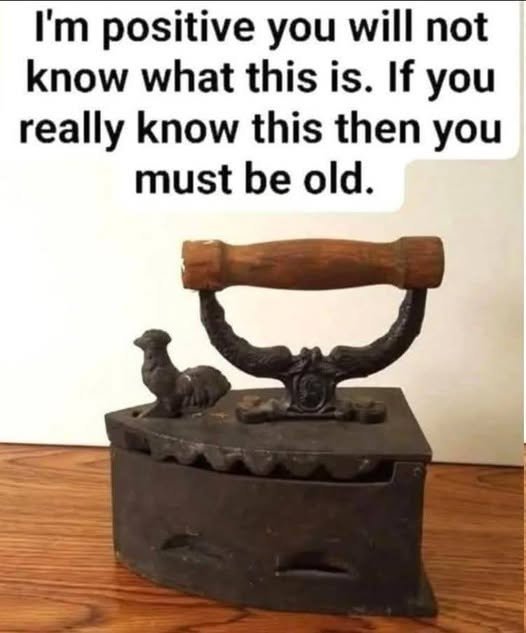
“I’m positive you will not know what this is. If you really know this, then you must be old!”
This popular challenge has been circulating online, bringing back memories of a time when everyday household chores required much more effort than they do today. The unusual object in the photograph may look like a heavy metal box with a wooden handle, but it is actually a traditional charcoal iron, an old-fashioned tool used to press wrinkles out of clothing before modern electric irons became widespread.
For older generations, it may be a familiar sight. For younger people, it can be a fascinating glimpse into the history of everyday life.
What Is This Strange-Looking Object?
The object is a type of antique charcoal-heated clothes iron, sometimes called a charcoal box iron. Unlike today’s electric models, it relied on burning charcoal to produce the heat needed for ironing.
Its heavy metal body was designed to retain heat, while the wooden handle made it easier to hold and move across fabric. Many traditional irons had a hollow chamber that could be opened to add fuel.
Although the example in the photograph has an unusual decorative handle, its precise age, manufacturer, and country of origin cannot be confirmed from the image alone.
How Did People Use a Charcoal Iron?
Before electric appliances became common in homes, ironing clothes was a task that required preparation and patience.
Here is how a typical charcoal iron worked:
The charcoal was prepared. Small pieces of charcoal were heated until they could provide a steady source of warmth.
The charcoal was placed inside the iron. The fuel chamber held the hot pieces while the metal body absorbed their heat.
Air circulated through openings. Depending on the design, vents helped maintain combustion and allowed hot gases to escape.
The iron was moved over the fabric. The heated base pressed out wrinkles as the user carefully moved it back and forth.
Because the temperature was difficult to control, people had to work carefully to avoid scorching or damaging their clothes.
Why Does It Have a Wooden Handle?
The wooden handle was an important practical feature. Wood generally transfers heat less readily than metal, helping the user grip the iron without directly holding its hot body.
However, this did not make the tool completely safe. Heat could still reach the handle, and the iron’s metal surfaces could become hot enough to cause serious burns.
The design reflects a time when household tools were often built around simple materials and practical mechanical solutions.
What Did People Use Before Charcoal Irons?
Charcoal irons were only one part of the long history of ironing.
Solid flat irons were heavy metal blocks heated on a stove or another heat source. Families sometimes kept several irons so one could be heating while another was being used.
Box irons had a hollow interior that could hold hot charcoal or another heat source. Their construction allowed the metal base to stay warm during use.
Electric irons eventually transformed the process by providing controllable heat without the need to prepare burning fuel. Modern models may also include steam functions, temperature controls, and automatic shutoff features.
The change from charcoal to electricity made ironing much more convenient for many households.
Was Ironing Really That Difficult in the Past?
For many families, yes. Preparing the fuel, waiting for the iron to heat, maintaining a suitable temperature, and avoiding damage to clothing all required attention.
People also had to manage the practical challenges of laundry without today’s washing machines, dryers, and specialized fabric-care products.
What is now a routine household chore could once take considerable time and effort, especially in large households where many garments needed to be pressed.
Could This Antique Iron Be Worth Money Today?
Some antique charcoal irons attract collectors interested in traditional tools, domestic history, and vintage household objects.
Their value depends on several factors:
Condition: An intact iron with its original handle and working parts may attract more interest.
Rarity: Unusual designs or less common models can be especially appealing.
Maker’s marks: Stamped names or markings can help establish a manufacturer’s identity.
Provenance: Information about where the object came from or how it was used may add historical interest.
Not every old iron is valuable, and its appearance alone cannot establish its market price. An antique dealer or specialist may be able to provide a more informed estimate.
A Reminder of How Much Everyday Life Has Changed
Objects like this charcoal iron remind us that technological progress is not always about spectacular inventions. Sometimes, it is about making ordinary tasks easier, faster, and safer.
A chore that once involved hot charcoal and a heavy metal tool can now be completed with a compact electric appliance. Yet these older objects remain valuable reminders of the ingenuity and resourcefulness of previous generations.
Perhaps the most interesting part is not simply identifying the iron, but imagining the people who used it every day and the stories it could tell about their lives.
Do You Remember Seeing One of These?
Have you ever seen a charcoal iron in your grandparents’ home, at a museum, or in an old family photograph? Perhaps someone in your family remembers using one.
Leave a comment below and share your memories! And if you recognize this particular design, tell us where you have seen one before. Your experience might help others discover more about this fascinating piece of household history.