Orange peels usually end up in the trash, but they can have a second life. The colorful peels contain aromatic oils, particularly limonene, which is widely used in household cleaning products.
That is why viral posts showing orange peels soaking in bottles have attracted so much attention. However, the claim that orange peels in water can “do anything” or replace every cleaning product is exaggerated.
Here’s what you can realistically make—and how to do it safely.
Why Save Orange Peels?
The outer orange peel contains natural oils that give citrus its familiar smell. Limonene is also a useful solvent for helping loosen some greasy residues.
Instead of immediately throwing the peels away, you can use them for:
A homemade citrus-infused cleaning solution
Freshening unpleasant odors
Adding fragrance to vinegar-based cleaners
Composting
Making citrus-infused household products
An Easy Orange-Peel Cleaning Solution
One of the simplest approaches is to make a citrus-infused vinegar cleaner.
You’ll need:
Fresh orange peels
White vinegar
A clean glass jar
A strainer
A spray bottle
Water
How to make it:
Wash the oranges before peeling them.
Place the peels in a clean glass jar.
Pour enough white vinegar over them to completely cover the peels.
Close the jar loosely or use a suitable lid and leave it in a cool, dark place for about 1–2 weeks.
Strain out the peels.
Dilute the infused vinegar with water, commonly around 1 part infused vinegar to 1 part water.
Transfer it to a labeled spray bottle.
The resulting solution can be useful for cleaning some washable household surfaces and for cutting through light grease and grime.
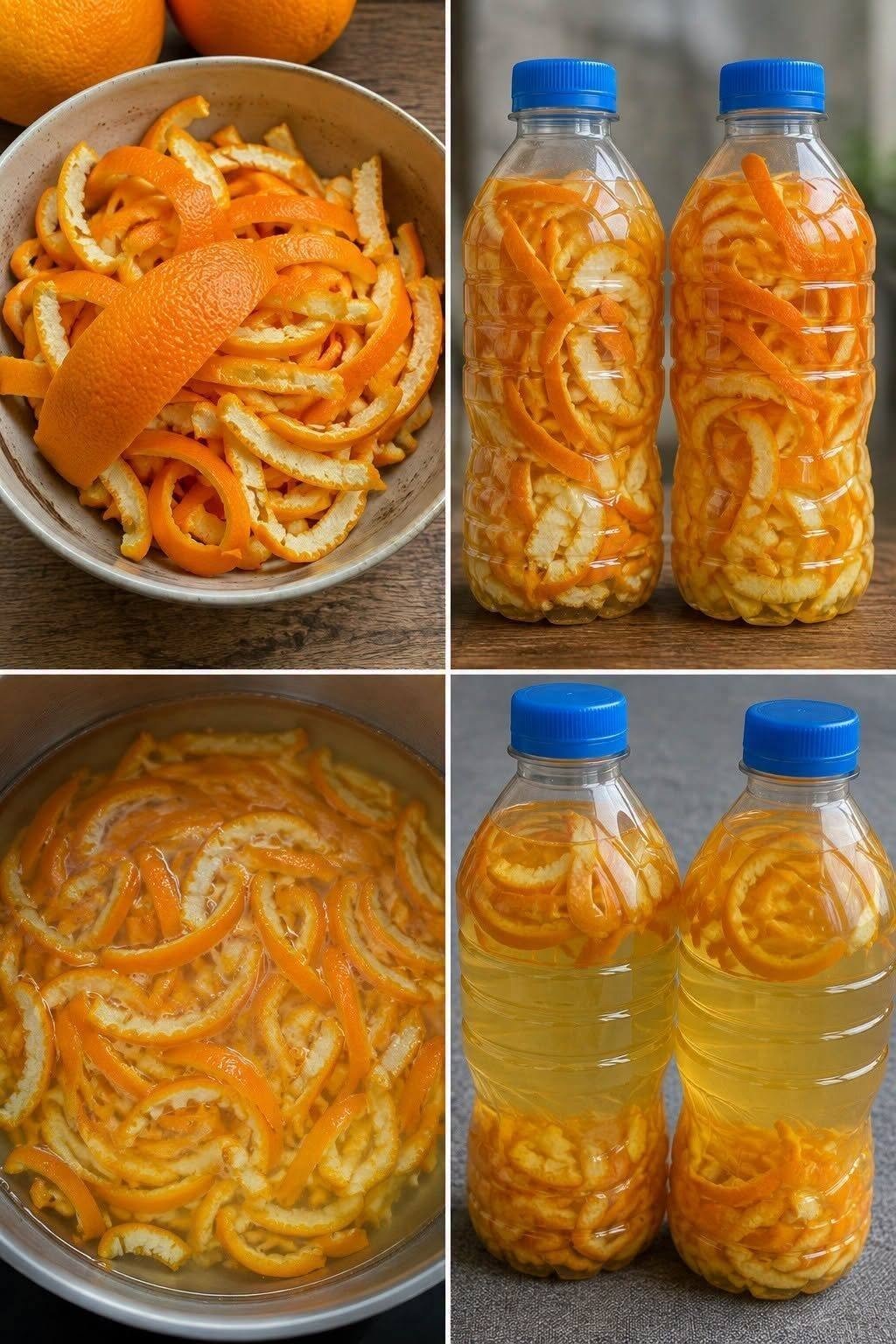
What About the Bottles in the Viral Picture?
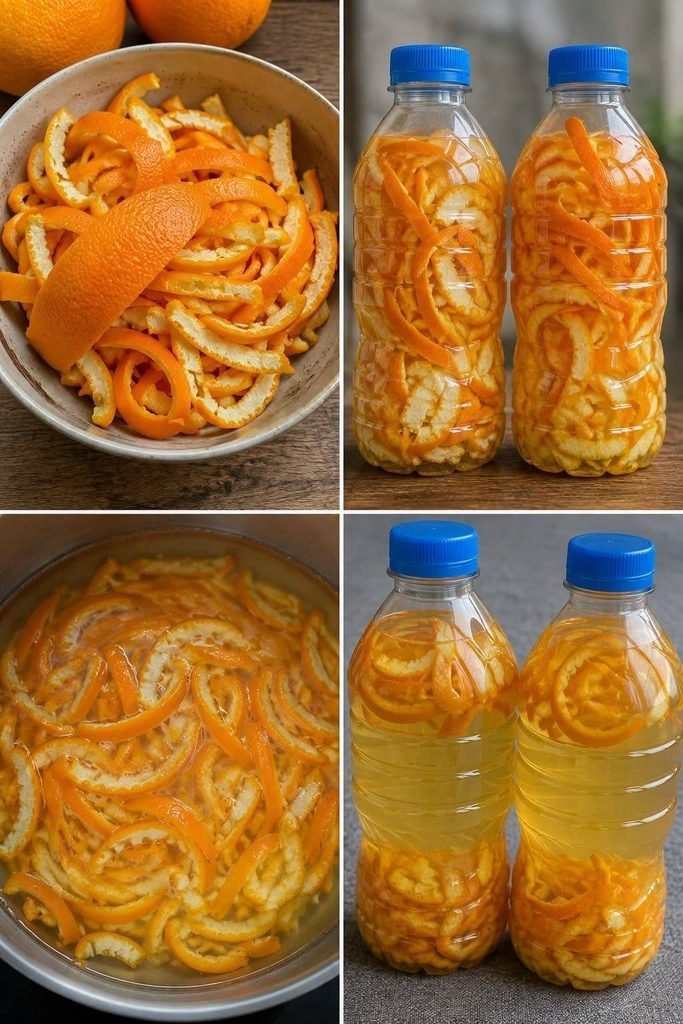
The image shows orange peels placed into plastic bottles with liquid. Posts like this often describe the process as making a fermented “orange enzyme cleaner.”
There is an important safety issue here: fermentation produces gas.
If orange peels, sugar and water are left to ferment inside a tightly sealed bottle, pressure can build up. A bottle can swell, leak, or potentially burst.
For that reason, homemade fermented mixtures should not be tightly sealed during active fermentation unless you are using equipment specifically designed to safely release fermentation gases.
Also, don’t assume that a fermented orange-peel mixture is a disinfectant. A homemade citrus cleaner is not a substitute for a properly tested disinfectant.
What Can You Clean With It?
A diluted citrus-vinegar cleaner may be useful on appropriate, acid-resistant surfaces such as:
Some stainless-steel surfaces
Ceramic surfaces
Certain countertops
Sinks
Some glass surfaces
Areas with light grease or mineral residue
Always test a small inconspicuous area first.
Surfaces to Avoid
Vinegar is acidic, so this homemade cleaner isn’t appropriate for everything.
Avoid using vinegar-based cleaners on marble, limestone, travertine and other natural stone surfaces, because acids can etch and damage them.
Be particularly careful with:
Unsealed stone
Certain wood finishes
Delicate metals
Electronic equipment
Surfaces with manufacturer’s warnings against acidic cleaners
And never mix vinegar with bleach or chlorine-containing products. The combination can produce dangerous chlorine gas.
Can Orange Peels Really Save You Money?
They can help you make better use of something that would otherwise become kitchen waste, but the savings shouldn’t be exaggerated.
A homemade cleaner can be inexpensive, particularly if you already have orange peels and vinegar at home. But it doesn’t replace every specialized household cleaning product.
The biggest benefit is simple: you are giving your food scraps another useful purpose before throwing them away.
Another Great Use: Compost
If you don’t want to make a cleaner, orange peels can also go into a composting system.
They contain organic material that can eventually return nutrients to the soil. Cut larger pieces into smaller pieces to help them break down more easily.
The Bottom Line
Orange peels aren’t worthless kitchen waste. Their natural citrus oils can be useful, and an orange-peel-infused cleaner can be a pleasant, inexpensive addition to your household cleaning routine.
But viral claims suggesting that soaking peels in a bottle creates a miracle product should be treated with caution.
Reuse the peels, but do it safely—and remember that “natural” doesn’t automatically mean harmless or universally effective.