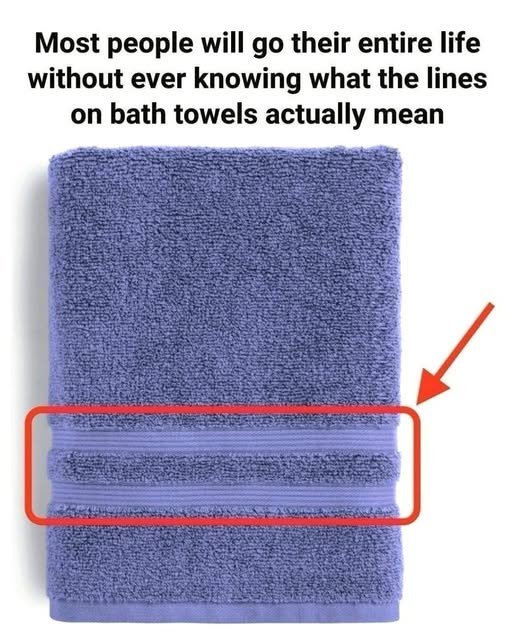
Have you ever noticed the narrow woven bands running across the ends of your bath towel?
They may look like simple decoration, but many people have heard that these lines have a practical purpose. Social media posts often claim they prevent towels from unraveling, help them dry faster, or even indicate how the towel should be folded.
So, what are those mysterious lines actually for?
The answer is simpler—and more interesting—than you might expect.
What Are the Lines on a Bath Towel Called?
The patterned bands found near the ends of many towels are commonly called dobby borders or dobby stripes.
Unlike the fluffy terry portion of the towel, these sections are woven using a different structure. They can be made with various geometric patterns, stripes, or textured designs.
Their appearance varies from towel to towel, but the purpose is generally a combination of design, construction, and durability.
Why Are They Woven Differently?
The main body of a bath towel is made from terry loops.
Those loops are what give a towel its soft, absorbent, fluffy texture. The loops also create a lot of surface area, allowing the towel to absorb water effectively.
The border, however, is usually woven more tightly and has a flatter texture.
This creates a transition between the highly absorbent terry fabric and the finished edge of the towel.
It Also Gives the Towel Structure
The flatter woven section can help create a stable area at the towel’s ends and contributes to the overall construction of the towel.
But it’s important not to overstate this: the border isn’t simply a magical anti-fraying strip. The towel’s hem and the way the fabric is woven and finished are also important in preventing unraveling.
So Is It Just Decoration?
Not entirely.
One of the major reasons manufacturers use these bands is aesthetic.
A completely plain terry towel can look very basic. Adding a woven border gives manufacturers a way to introduce texture and pattern without sacrificing the absorbent terry surface over most of the towel.
That’s why you’ll find everything from a single narrow stripe to elaborate geometric patterns.
In other words, the border is both functional and decorative.
Does the Border Make the Towel More Absorbent?
No.
In fact, the opposite is generally true.
The smooth woven border contains fewer exposed terry loops than the main body of the towel, so it isn’t the part doing most of the water absorption.
When you dry your hands or body, the fluffy terry loops are primarily responsible for soaking up moisture.
Does It Tell You Where to Fold the Towel?
This is another popular claim online, but there isn’t a universal rule saying that the border is specifically a folding guide.
You can certainly use the border as a convenient visual reference when folding or hanging a towel, but that’s not its fundamental purpose.
Different towels have different border widths and designs, and manufacturers don’t generally use the stripes as standardized folding instructions.
Why Do Some Towels Have One Stripe and Others Have Several?
It’s largely a matter of design and manufacturing.
The woven pattern can be changed to create different appearances and textures. Some towels have:
One narrow band
Several thin stripes
Wide geometric patterns
Intricate woven designs
Borders matching the towel’s color
Contrasting decorative bands
Hotels, spas and luxury towel manufacturers often use these borders to create a more polished appearance.
What Happens If the Border Is Damaged?
If the woven border becomes damaged, you may notice loose threads or unraveling.
Don’t pull on a loose thread. Pulling can make the problem worse.
Instead, carefully trim a loose thread with scissors if appropriate, or repair the edge if the damage is significant.
Proper washing and drying also matter. Excessive heat, harsh detergents and aggressive mechanical action can shorten the life of towels.
How to Keep Your Towels Looking Good
If you want your towels to remain soft and absorbent for as long as possible:
1. Don’t overload the washing machine
Towels need room to move around during washing. An overloaded machine may not clean or rinse them effectively.
2. Avoid using too much detergent
More detergent doesn’t necessarily mean cleaner towels. Excess detergent can accumulate in fabric and make towels feel stiff.
3. Don’t overuse fabric softener
Fabric softeners can coat fibers and reduce the towel’s ability to absorb water over time.
4. Dry them properly
Follow the care label and avoid excessive heat, which can gradually damage fibers.
5. Wash towels regularly
Damp towels can develop unpleasant odors when they’re left bunched up for long periods. Hang them so they can dry thoroughly between uses.
The Bottom Line
Those mysterious lines across your bath towel aren’t a secret code—and they aren’t there solely to tell you where to fold it.
They’re usually woven decorative borders, often called dobby borders, that provide a different, more tightly woven structure from the fluffy terry portion of the towel.
They contribute to the towel’s appearance and construction, while the terry loops do most of the work when it comes to absorbing water.
So the next time you grab a bath towel, take a closer look at that seemingly ordinary strip.
It’s not just a random line—it’s part of the way the towel is designed and made.