Have you ever boiled an egg, cut it open, and wondered whether the yolk was too runny, too firm, or just right?
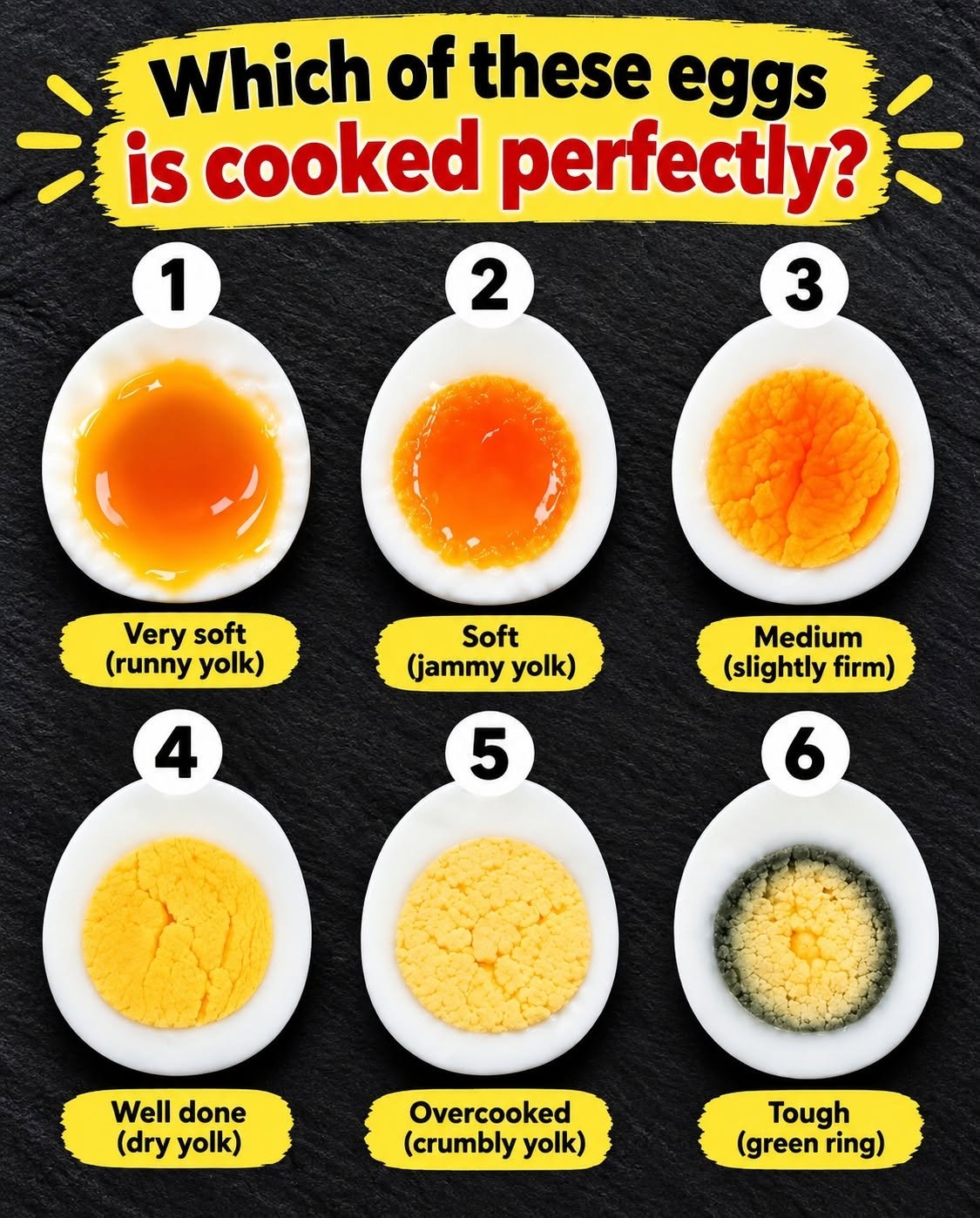
This viral image shows six different stages of cooked egg yolks—from very soft and runny to overcooked with a green ring.
But which one is actually “perfect”?
The answer depends on what you want from your egg.
There isn’t one universal definition of a perfectly cooked egg. However, if you’re looking for a classic hard-boiled egg with a fully set white and a tender, moist yolk, egg #4 is much closer to the ideal than #5 or #6.
Let’s break down what you’re seeing.
🥚 #1 — Very Soft, Runny Yolk
The first egg has a liquid center.
This is similar to a very soft-boiled egg or an egg that has been cooked briefly.
Some people love this texture because the yolk is rich, creamy, and almost sauce-like.
Best for:
Toast and dipping
Ramen
Breakfast dishes
Soft-boiled egg recipes
However, because the yolk remains substantially runny, this isn’t what most people mean when they ask for a hard-boiled egg.
If food safety is a concern, particularly for young children, older adults, pregnant people, or people with weakened immune systems, fully cooked eggs are generally the safer choice.
🥚 #2 — Soft “Jammy” Yolk
This is the famous jammy egg.
The center is thick and creamy rather than liquid.
It’s one of the most popular textures for eggs served with ramen, toast, salads, and other dishes.
The yolk has enough moisture to remain silky but is firm enough that it doesn’t pour everywhere when cut.
Is it perfectly cooked?
For many food lovers, yes!
If your idea of the perfect boiled egg is a creamy, slightly set yolk, #2 may be your favorite.
🥚 #3 — Medium, Slightly Firm
Here the yolk is more set but still has some moisture and softness.
This is a good middle ground between a jammy egg and a traditional hard-boiled egg.
It’s especially useful when you want a yolk that holds its shape while retaining a pleasant texture.
🥚 #4 — Well Done, but Still Moist
Now we get to the classic hard-boiled egg.
The yolk is completely set, but it doesn’t appear excessively dry.
For someone looking for a traditional fully cooked boiled egg, this is arguably the best-looking option in the graphic.
The ideal hard-boiled egg should have:
A fully set white
A fully cooked yolk
A reasonably moist, tender texture
No unpleasant sulfur smell
No large green-gray ring around the yolk
So if the question is “Which one is the perfect hard-boiled egg?”, #4 is the strongest answer from this image.
🥚 #5 — Overcooked and Crumbly
This yolk is much drier and more crumbly.
It is still recognizable as a cooked egg, but the texture isn’t usually what people are aiming for.
Overcooking can make the yolk dry and give the egg a stronger sulfur-like aroma.
This doesn’t necessarily mean the egg is unsafe to eat simply because it is overcooked, but the eating quality can suffer.
🥚 #6 — The Green Ring
You’ve probably seen this before.
You cut open a boiled egg and discover a gray-green ring surrounding the yolk.
It can look alarming.
But in most cases, it doesn’t mean the egg has gone bad.
Why does the green ring appear?
It’s generally caused by a reaction involving sulfur from the egg white and iron from the yolk when the egg is cooked for too long or at excessive heat.
The resulting iron sulfide produces the familiar greenish-gray color.
Is it dangerous?
Usually, no.
The green ring is primarily a sign of overcooking rather than spoilage.
The egg may simply have a less pleasant texture and flavor.
So, Which Egg Is “Perfect”?
It depends on your preference.
If you like a runny yolk:
#1
If you love a creamy, jammy center:
#2
If you want a moderately set yolk:
#3
If you want a classic hard-boiled egg:
#4
If you prefer a very firm, dry yolk:
#5
If you see a green ring:
#6 — you’ve probably cooked it longer than necessary.
For an everyday hard-boiled egg, #4 is the best choice in this graphic.
How to Boil Eggs Without Overcooking Them
One of the easiest ways to improve your boiled eggs is to stop relying entirely on guesswork.
1. Place the eggs in a saucepan
Arrange them in a single layer if possible.
2. Cover with water
Use enough water to cover the eggs by roughly an inch or two.
3. Bring the water to a boil
Heat until the water reaches a proper boil.
4. Adjust the cooking time to your desired texture
The exact time varies depending on egg size, starting temperature, altitude, and cooking method, but as a general guide:
About 5–6 minutes: soft/jammy
About 7–9 minutes: medium to mostly set
About 10–12 minutes: firm hard-boiled
These are approximate rather than universal rules.
The Ice Bath Trick
Once the eggs have reached your preferred level of doneness, transfer them to ice water or very cold water.
This does several useful things:
Stops the cooking process
Helps prevent overcooking
Makes the eggs easier to handle
Can make peeling easier
Let them cool before peeling.
If you’re preparing several eggs at once, an ice bath is particularly useful because it prevents residual heat from continuing to cook the yolks.
Don’t Boil Them Forever
A common mistake is thinking:
“I’ll just leave them boiling a little longer to make sure they’re cooked.”
That’s how you end up with dry yolks and sometimes the dreaded green ring.
Once the egg has reached the texture you want, cool it quickly.
You don’t gain much by continuing to cook it after the yolk is already fully set.
Does a Green Ring Mean the Egg Is Bad?
Not necessarily.
This distinction is important.
Overcooking and spoilage are not the same thing.
A green-gray ring around an otherwise properly stored, fresh egg is generally associated with the cooking process.
However, if an egg has an unusual rotten odor, strange appearance, damaged shell, or has been stored improperly, don’t eat it simply because the yolk looks normal.
When in doubt, throw it out.
What About the Gray or Green Color?
The color can range from a subtle gray line to a much more obvious green ring.
The longer or more intensely the egg is cooked, the more likely you are to notice it.
It can also be influenced by factors such as cooking conditions and the chemistry of the particular egg.
Fortunately, avoiding excessive cooking usually prevents the problem.
The Real Secret to a Better Boiled Egg
The biggest lesson isn’t that one particular yolk is universally “perfect.”
It’s this:
Cook the egg for the texture you actually want—and stop cooking it once you get there.
If you want a creamy ramen-style egg, don’t cook it until the yolk is completely dry.
If you’re making deviled eggs, you probably want the yolk fully set.
And if you’re preparing eggs for someone at higher risk from foodborne illness, fully cooked eggs are generally the safer choice.
Final Answer 🥚
Looking at the six eggs in the image, #4 is the best choice for a classic fully cooked hard-boiled egg: the yolk is set without appearing excessively dry.
But if your definition of “perfect” means creamy and jammy, then #2 may be the winner.
The important thing is to avoid assuming that the driest yolk is the best one.
A great boiled egg should be cooked enough for your needs—but not so long that the yolk becomes dry, crumbly, or develops a green ring.
So, which one would you choose: #2 for creamy and jammy, or #4 for a classic hard-boiled egg? 🥚🍽️