At first glance, this old metal machine might look like a strange piece of workshop equipment. But if you grew up in an older home—or spent time in your grandparents’ kitchen—you may recognize it immediately.
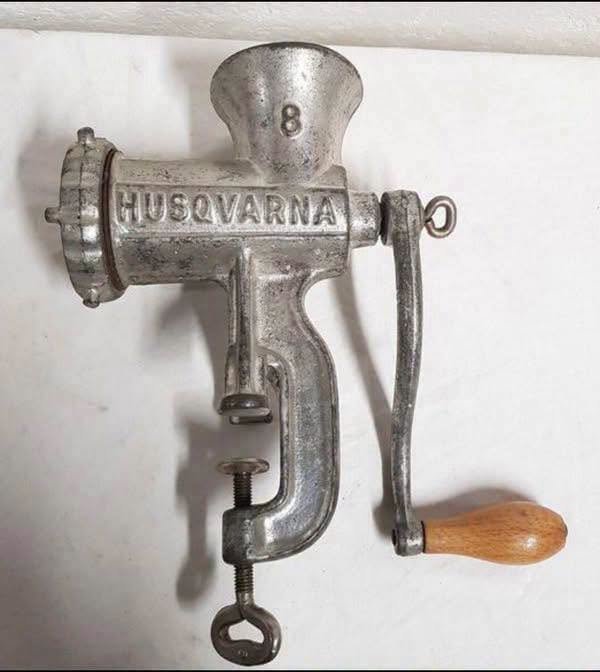
The tool in the photograph is a vintage Husqvarna hand-crank meat grinder.
Before electric kitchen appliances became common, hand-operated grinders like this were widely used to process meat at home. They were mounted firmly to the edge of a table or countertop, and the user turned the wooden handle to operate the internal grinding mechanism.
How Did It Work?
The design is remarkably simple.
The grinder has a large opening at the top where pieces of meat could be added. As the crank was turned, an internal screw mechanism pulled the meat forward toward a rotating blade and perforated metal plate.
The meat was then pushed through the holes in the plate, producing the familiar ground-meat texture used for dishes such as meatballs, sausages, burgers and various traditional recipes.
Unlike modern electric grinders, this machine required no electricity at all.
Just attach it securely, place the food into the hopper, and turn the handle.
Why Does It Have a Clamp?
The large clamp underneath is one of the most recognizable features of these old-fashioned grinders.
It was designed to attach the grinder securely to a table or countertop.
Once tightened, the grinder would remain firmly in place while the user rotated the crank.
That simple mechanical design made these machines practical, durable and surprisingly long-lasting.
The Wooden Handle Wasn’t Just for Looks
The wooden handle made turning the crank more comfortable.
As the handle rotated around the grinder, the operator could maintain a steady rhythm while feeding meat into the top opening.
There were no buttons, motors or electrical components—just metal, gears, a screw mechanism and human power.
Why Are People Still Interested in These Today?
One reason is durability.
Many vintage kitchen tools were built with heavy cast metal and relatively simple mechanical parts. When properly maintained, some can remain functional for decades.
Collectors also appreciate these machines because they represent an era when kitchen equipment was designed to be repaired and reused rather than quickly replaced.
And there is something fascinating about seeing a tool that could perform an everyday household task without electricity.
A Piece of Kitchen History
Today, most people would probably reach for an electric food processor or modern meat grinder. But this vintage Husqvarna grinder reminds us that preparing food once required considerably more physical effort.
You supplied the power.
The machine did the rest.
And that’s perhaps what makes old kitchen tools so interesting: their designs may look simple, but they were carefully engineered to accomplish a practical job using nothing more than basic mechanical principles.
Have You Ever Seen One?
Maybe your grandparents had one sitting in a kitchen cupboard, basement or storage room.
Do you remember using one of these old hand-crank grinders? What did your family use it to make?