You’ve probably seen one of those viral graphics claiming that your sleeping position determines how lazy you are.
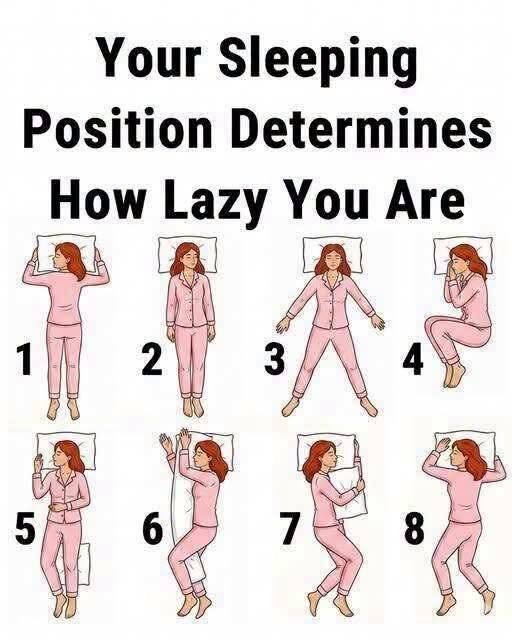
The image shows eight different sleeping positions, each suggesting a different personality type.
It may be fun to check which one looks most like you—but there’s an important catch:
There is no reliable scientific evidence that your sleeping position can tell you whether you’re lazy.
Still, the positions themselves are interesting, and the way you sleep can sometimes be connected to comfort, habits, body temperature, pain, and even certain health conditions.
Let’s take a closer look at the common positions shown in the viral image.
1. Sleeping Flat on Your Back
The first position shows someone lying on their back with their arms positioned near their head.
Back sleeping is sometimes called the supine position.
For some people, sleeping on the back can help keep the spine relatively neutral, especially when the mattress and pillow provide appropriate support.
However, it isn’t ideal for everyone.
People who snore or have obstructive sleep apnea may experience worse symptoms when sleeping on their backs because gravity can allow the tongue and other tissues to fall backward and narrow the airway.
What it says about your personality
The viral graphic may attach a personality characteristic to this position, but that’s entertainment—not a scientific personality assessment.
2. Sleeping Straight on Your Back
The second illustration shows someone lying relatively straight with their arms alongside their body.
This is another form of back sleeping.
Some people naturally prefer this position because it allows the body to remain relatively symmetrical and relaxed.
If you’re comfortable and sleeping well, there’s generally no reason to change your position simply because an internet personality chart says you should.
3. The Starfish Position
The third position shows a person lying on their back with their arms and legs spread outward.
This is commonly referred to as the starfish position.
It gives the sleeper plenty of room and may feel comfortable for people who like to stretch out.
However, spreading out isn’t an indication of laziness.
In fact, there’s no established medical or psychological test that can determine someone’s work ethic based on how they sleep.
4. The Fetal Position
The fetal position is one of the most common sleeping positions.
It involves lying on your side with your knees drawn toward your chest.
Many people find this position comfortable because it provides a sense of physical security and warmth.
A possible benefit
Side sleeping can be helpful for some people who snore or have sleep apnea.
Pregnant people are also often encouraged to sleep on their side, particularly later in pregnancy, although individual medical advice can vary.
If you sleep in a tightly curled fetal position and wake up with stiffness, try relaxing the knees slightly and using a pillow between them.
5. The Side Sleeper
The fifth illustration shows someone lying on their side with one arm positioned in front of the body.
Side sleeping is extremely common.
It may help reduce snoring for some people and can be more comfortable for people who have certain types of back discomfort.
A pillow between the knees can help maintain a more comfortable alignment of the hips and spine.
One thing to watch
If your pillow is too high or too low, your neck may remain bent for hours.
Choosing a pillow that keeps your head and neck in a comfortable, neutral position can make a noticeable difference.
6. The Side Sleeping “Reach” Position
This position is another variation of side sleeping, with the arms extended forward.
Again, there’s nothing inherently lazy—or hardworking—about it.
Your preferred position may simply be the one that allows your muscles to relax.
Some people also change positions several times throughout the night without realizing it.
7. The “Hugging the Pillow” Position
Some people naturally sleep while hugging a pillow or another object.
It can feel comforting and may help support the upper arm and shoulder.
If you’re a side sleeper, hugging a pillow can also prevent the upper arm from dropping forward and may make the position more comfortable.
It’s completely normal.
8. The Mixed or Relaxed Side Position
The final illustration shows another side-sleeping variation, with one leg extended and the arms positioned differently.
There are countless variations of sleeping positions.
Most people don’t remain perfectly still all night, either.
You may fall asleep in one position and wake up in a completely different one.
So, Does Your Sleeping Position Reveal Your Personality?
Not reliably.
There have been studies examining sleep posture and personality, but popular claims that specific sleeping positions reveal whether someone is “lazy,” “confident,” “anxious,” “creative,” or “successful” are generally much stronger than the available evidence supports.
Your sleeping position can be influenced by many ordinary factors, including:
Mattress firmness
Pillow height
Room temperature
Habit
Body shape
Pregnancy
Joint or back discomfort
Snoring
Breathing problems
Personal comfort
In other words, you probably aren’t sleeping like a starfish because your personality says you should.
You may simply like having room to stretch out. 😄
Your Sleeping Position Can Still Tell You Something Useful
Although it can’t reliably tell you how lazy you are, your sleeping position can provide clues about sleep comfort and certain physical symptoms.
For example:
If you wake with neck pain
Your pillow or sleeping position may not be providing adequate support.
If you frequently snore
Your sleep position could be contributing to airway narrowing.
If you wake with shoulder pain
The way you position your arm and shoulder may be worth examining.
If you regularly wake with lower-back stiffness
Your mattress, pillow arrangement, and sleeping position could all play a role.
These are much more useful questions to ask than whether your position means you’re lazy.
What’s the “Best” Sleeping Position?
There isn’t one perfect position for everyone.
For many adults, side sleeping is a good option, particularly for people who snore or have certain breathing problems.
Back sleeping can also be comfortable and supportive for some people.
Stomach sleeping is generally less favorable for the neck and spine because the head must be turned to one side for breathing, but some people still find it comfortable.
Ultimately, the best position is usually the one that allows you to sleep comfortably and wake without significant pain or stiffness, while also taking any medical conditions into account.
Don’t Let a Viral Personality Test Decide Your Sleep
These graphics are fun because everyone wants to find out:
“Which one am I?”
But they’re better treated as entertainment than as psychological science.
Your sleeping position doesn’t determine your motivation, intelligence, personality, or work ethic.
And if you happen to sleep sprawled across the entire bed, it doesn’t mean you’re lazy.
It might simply mean you’ve claimed the whole mattress. 😂
The Bottom Line
Your sleeping position can affect comfort, breathing, and sometimes symptoms such as snoring or stiffness—but there is no good evidence that it determines how lazy you are.
So check the image, find the position that looks most like yours, and have fun with it.
Then forget the personality label and pay attention to what really matters:
Are you sleeping well, waking refreshed, and feeling comfortable?
If the answer is yes, your sleeping position is probably doing its job. 💤
Medical note: If you regularly wake feeling exhausted, have loud or persistent snoring, gasp or choke during sleep, or experience significant daytime sleepiness, talk with a healthcare professional. These can sometimes be signs of a sleep disorder such as obstructive sleep apnea.