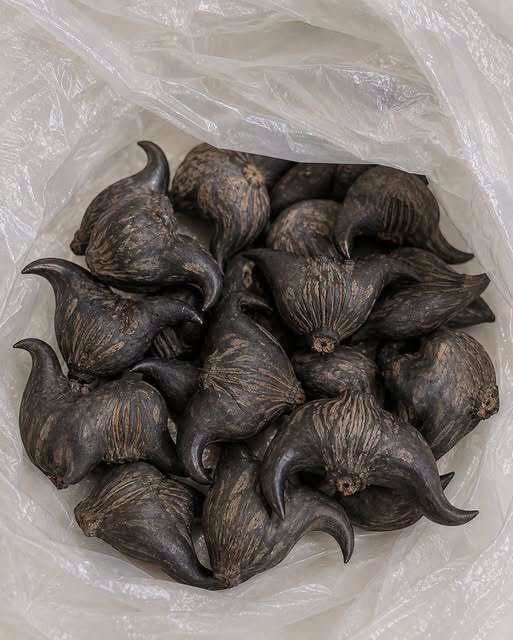
At first glance, these strange black objects look more like animal horns, shells, or something from a fantasy movie than something you’d find in a bag of food.
But they’re actually a type of edible plant seed known as a water caltrop, commonly called water chestnut in some regions.
They are especially associated with Trapa species and have been eaten in parts of Asia for centuries.
And yes—the strange curved “horns” are completely natural.
What Are These Strange Things?
The objects in the photograph appear to be water caltrops, the hard fruits produced by aquatic plants in the genus Trapa.
Depending on the species, they can have two or more prominent pointed projections, giving them an unusual appearance.
They may be known by names such as:
Water caltrop
Buffalo nut
Devil’s nut
Ling jiao
Bat nut
Horned water chestnut
Names vary considerably from country to country, so identifying them by appearance and local food traditions is more reliable than relying on a common name.
The dark, wrinkled exterior is the hard shell surrounding the edible portion.
Why Do They Look Like Little Horns?
The unusual shape isn’t accidental.
The fruits develop underwater and have hard, pointed projections. These structures help the plant’s seeds disperse and anchor in muddy environments.
Once dried, the fruits can become extremely hard.
That’s why they look almost like miniature pieces of carved wood—or even animal horns.
Their appearance has also inspired some of their colorful common names.
Is There Something You Can Eat Inside?
Yes.
The edible portion is the seed inside the hard shell.
The outer shell isn’t what you eat.
Think of it somewhat like cracking a nut: the interesting part is protected inside a hard outer covering.
The exact appearance and flavor of the edible kernel varies with the species and how it is prepared.
How Are Water Caltrops Traditionally Eaten?
One traditional approach is to cook them first.
Depending on the variety and local culinary tradition, water caltrops may be:
Boiled
Steamed
Roasted
Added to soups
Added to savory dishes
Used in traditional snacks
Ground into flour in some culinary traditions
After cooking, the hard shell is removed and the kernel inside can be eaten.
The cooked kernel is often described as having a mild, slightly sweet and nutty flavor, with a texture somewhat different from ordinary tree nuts.
Don’t Bite Into the Shell
This is particularly important if you’ve never handled them before.
The exterior is extremely hard, and the pointed projections can be sharp.
Don’t try to crack one with your teeth.
Depending on how they’re prepared, people traditionally use appropriate kitchen tools or remove the shell after cooking.
If you’re unsure how the particular variety given to you should be prepared, ask the person who gave them to you where they came from and how they normally eat them.
Are They the Same as Water Chestnuts?
This is where things get confusing.
Despite the name, water caltrops (Trapa species) are not the same plant as the familiar canned or fresh water chestnut used in stir-fries.
Asian water chestnuts commonly sold for cooking are the underground corms of Eleocharis dulcis.
Water caltrops are completely different plants.
The two are sometimes confused because both are aquatic foods and both have common names involving “water chestnut.”
What Do They Taste Like?
Descriptions vary depending on the species and preparation, but cooked water caltrop kernels are generally considered mild and somewhat nutty or starchy.
They’re not usually eaten because they have an overwhelmingly strong flavor.
Instead, their appeal comes from their texture and the novelty of the food itself.
In some regions, they’re a seasonal snack and are eaten after cooking and peeling.
Are They Safe to Eat Raw?
This is where it’s best to be cautious.
Don’t assume that an unidentified wild plant or seed is safe to eat simply because it looks like a water caltrop.
Some Trapa fruits are traditionally eaten, but the exact species, condition, storage history, and preparation matter.
If these were simply handed to you in a plastic bag with no information about their origin, the safest approach is to confirm exactly what they are and how they were harvested and prepared before eating them.
Also avoid eating anything that is moldy, rotten, contaminated, or of uncertain origin.
Why Are They So Popular in Some Countries?
Water caltrops have a long history as a food in parts of Asia.
In some regions, they’re sold during their growing season by street vendors or markets, where they’re commonly cooked before being eaten.
The plants grow in freshwater environments, and their fruits can be harvested when mature.
They’ve also been incorporated into traditional cuisine and food products.
A Nut With a Very Unusual Appearance
One of the fascinating things about water caltrops is how dramatically different they look from the foods we’re accustomed to seeing in supermarkets.
From the outside, you’d probably never guess that there’s an edible seed hidden inside.
The dark shell, ridges, and curved points can make them look almost prehistoric.
But once the shell is removed, the edible kernel looks much more like an ordinary food.
So, What Did Your Neighbor Give You?
If the photograph is representative of the actual items, they appear to be water caltrops (Trapa species)—the unusual horned fruits sometimes sold as a traditional food.
The basic idea is:
🌱 Aquatic plant → hard horned fruit → cook → remove shell → eat the kernel.
But because several similarly shaped plant products can circulate under different names, don’t eat an unidentified batch solely on the basis of an internet photograph. Confirm the species and food preparation with the person who harvested or purchased them, or with a knowledgeable local food expert.
And whatever you do, don’t try to crack those horns with your teeth! 😄
Food-safety note: This article is for general information and does not establish that a particular batch is safe to eat. If the identity, source, or preparation history of the items is uncertain, have them positively identified before consuming them.