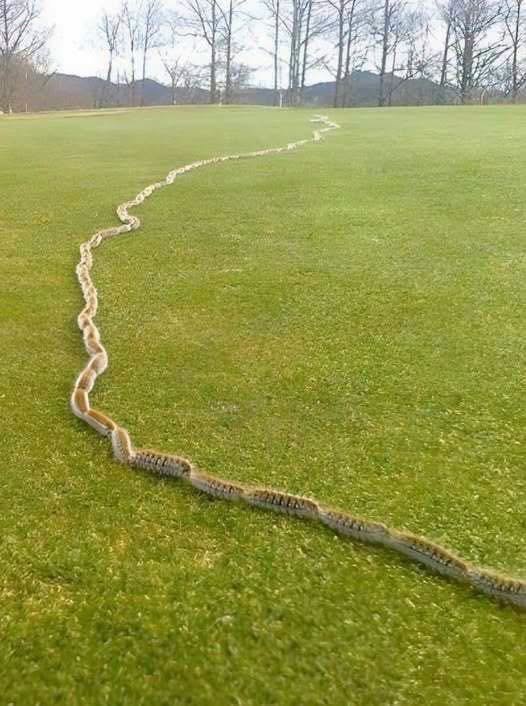
At first glance, the strange object stretched across the lawn looks almost like a long piece of rope or garden hose.
Then it starts moving.
And suddenly, the peaceful garden becomes a much more alarming place.
The photograph above shows what appears to be a long line of snakes moving through the grass, creating the illusion of one enormous snake. It is the kind of sight that would make almost anyone stop and take a second look.
But what exactly is happening here?
Is That Really One Giant Snake?
Probably not.
The image appears to show multiple snakes traveling close together, rather than a single snake that stretches across the entire lawn.
When several snakes move in the same direction and their bodies overlap visually, they can create an extraordinary “snake train” effect.
This is one reason photographs like this can be so misleading at first glance.
A single snake—even a very large one—would not normally produce a long, repeating pattern of separate-looking bodies extending across a field like this.
Why Would Snakes Move Together?
There are several reasons snakes may be found in groups.
Mating
One of the best-known examples occurs during the breeding season.
Some species gather in large numbers when males and females come together to mate. Garter snakes, for example, are famous for forming large mating aggregations.
A group of snakes can twist and crawl over one another, sometimes creating what looks like a living mass of snakes.
Searching for Food
Snakes may also appear in the same area when there is an abundant food source.
If a location contains plenty of rodents, frogs, insects, or other prey, several snakes may independently be attracted to the same place.
That doesn’t necessarily mean they’re cooperating. Many snake species are solitary animals.
Moving Between Habitats
Temperature and seasonal changes can also influence snake movement.
Snakes are ectothermic, meaning they rely on environmental heat to regulate their body temperature. As conditions change, they may move between areas where they can warm themselves, find shelter, or locate food.
This can sometimes result in several snakes being seen in the same general area.
Why Does the Photograph Look So Strange?
The biggest trick is perspective.
The snake—or snakes—closest to the camera appear much larger than the ones farther away.
As the line stretches toward the background, the bodies become smaller and harder to distinguish.
That creates the illusion of one enormous creature disappearing into the distance.
The grass also makes it difficult to see exactly where one animal ends and another begins.
From a distance, it could genuinely look like someone had dropped an enormous rope across the lawn.
Until the “rope” starts moving.
Could It Be a Giant Snake?
There are genuinely enormous snakes in the world.
Species such as green anacondas, reticulated pythons, Burmese pythons, and African rock pythons can reach impressive sizes.
But the apparent length in this photograph should not automatically be interpreted as the length of a single animal.
Images of unusually large snakes frequently circulate online, and perspective, multiple animals, image editing, and misleading captions can make an animal appear much larger than it really is.
That’s why photographs alone aren’t always enough to determine the species—or even the number of animals—in a viral image.
A “Snake Train” Doesn’t Mean Snakes Are Cooperating
Seeing several snakes moving together can give the impression that they are traveling as a coordinated group.
But snakes don’t generally behave like a herd of mammals.
Depending on the species and situation, they may simply be responding to the same environmental conditions.
If several snakes are heading toward the same warm, sheltered, or food-rich location, their paths can overlap.
The result can look remarkably organized even when each animal is acting independently.
Should You Be Worried If You See Something Similar?
Not necessarily.
Most snakes are not interested in attacking people.
When confronted, a snake will often attempt to escape rather than fight. However, that doesn’t mean you should approach or handle an unfamiliar snake.
Some species are venomous, and even nonvenomous snakes can bite if they feel threatened.
If you encounter a snake in your garden:
Keep children and pets away.
Give the animal plenty of space.
Don’t attempt to grab or corner it.
Don’t try to identify it by getting close.
If necessary, contact a local wildlife professional for safe removal.
If you’re in an area where venomous snakes are common, extra caution is appropriate.
What If There Really Are Several Snakes in Your Garden?
Finding one snake doesn’t automatically mean your property has an infestation.
Snakes may pass through gardens because they’re searching for food or shelter.
However, if you repeatedly see snakes, it may be worth looking at what is attracting them.
Potential attractions include:
Rodents
Frogs
Dense vegetation
Rock piles
Wood piles
Compost
Dark, sheltered spaces
Areas with abundant water
Reducing rodent populations and keeping gardens reasonably tidy can sometimes make an area less attractive to snakes.
Importantly, don’t use homemade poisons or dangerous chemicals to try to kill snakes. Such methods can harm pets, wildlife, and people and may also be illegal depending on local regulations.
The Fascinating World of Snake Aggregations
Large groups of snakes aren’t always something to fear.
In fact, they’re an important part of snake biology.
Some species gather in remarkable numbers during particular times of the year. In parts of North America, for example, thousands of garter snakes can emerge from communal winter dens when temperatures rise.
These gatherings can produce some truly spectacular—and slightly terrifying—photographs.
A lawn covered by a winding line of snakes would certainly qualify as one of those moments.
So, What Did the Garden Visitor Really See?
The photograph gives the impression of an impossibly long snake crossing the grass.
But the more likely explanation is multiple snakes or a perspective effect, rather than one monster-sized snake.
Without information about where the photograph was taken, the species involved, and whether the image has been edited or manipulated, it’s impossible to identify the animals with certainty from this photograph alone.
And that’s an important lesson with viral wildlife photographs:
Sometimes the most shocking part of the picture isn’t the animal—it’s the way the image makes us see it.
Final Thought
Imagine looking out your window at noon and seeing what appears to be a giant rope slowly crawling across your lawn.
You take another look.
It moves.
You realize it’s alive.
Then you notice that the “rope” may actually be made up of several snakes moving along the same path.
At that point, most people would probably do exactly what the person who captured the photograph did:
Stop, stare, and wonder, “What on earth am I looking at?” 😱🐍
Important: The exact species and circumstances shown in this viral photograph cannot be confirmed from the image alone. Snake identification should be based on reliable location and physical characteristics rather than a social-media caption. Never approach or handle an unfamiliar snake.